 Add to Chrome
 Add to Firefox
 Add to Edge
Learning a Delighting Prior for Facial Appearance Capture in the Wild
May 07, 2026
High-quality facial appearance capture has traditionally required costly studio recording. Recent works consider an in-the-wild smartphone-based setup; however, their model-based inverse rendering paradigm struggles with the complex disentanglement of reflectance from unknown illumination. To bridge this gap, we propose to shift the paradigm into training a powerful delighting network as a prior to constrain the optimization. We leverage the OLAT dataset and the rendered Light Stage scans for training, and propose Dataset Latent Modulation (DLM) to seamlessly integrate these heterogeneous data sources. Specifically, by conditioning the core network on learnable source-aware tokens, we decouple dataset-specific styles from physical delighting principles, enabling the emergence of a delighting prior that outperforms existing proprietary models. This powerful delighting prior enables a simple and automatic appearance capture pipeline that achieves high-quality reflectance estimation from casual video inputs, outperforming prior arts by a large margin. Furthermore, we leverage our appearance capture method to transform the multi-view NeRSemble dataset into NeRSemble-Scan, a large-scale collection of 4K-resolution relightable scans. By open-sourcing our model and the NeRSemble-Scan dataset, we democratize high-end facial capture and provide a new foundation for the research community to build photorealistic digital humans.

GraSP: Graph-Structured Skill Compositions for LLM Agents
Apr 20, 2026Skill ecosystems for LLM agents have matured rapidly, yet recent benchmarks show that providing agents with more skills does not monotonically improve performance -- focused sets of 2-3 skills outperform comprehensive documentation, and excessive skills actually hurt. The bottleneck has shifted from skill availability to skill orchestration: agents need not more skills, but a structural mechanism to select, compose, and execute them with explicit causal dependencies. We propose GraSP, the first executable skill graph architecture that introduces a compilation layer between skill retrieval and execution. GraSP transforms flat skill sets into typed directed acyclic graphs (DAGs) with precondition-effect edges, executes them with node-level verification, and performs locality-bounded repair through five typed operators -- reducing replanning from O(N) to O(d^h). Across ALFWorld, ScienceWorld, WebShop, and InterCode with eight LLM backbones, GraSP outperforms ReAct, Reflexion, ExpeL, and flat skill baselines in every configuration, improving reward by up to +19 points over the strongest baseline while cutting environment steps by up to 41%. GraSP's advantage grows with task complexity and is robust to both skill over-retrieval and quality degradation, confirming that structured orchestration -- not larger skill libraries -- is the key to reliable agent execution.
Strips as Tokens: Artist Mesh Generation with Native UV Segmentation
Apr 10, 2026Recent advancements in autoregressive transformers have demonstrated remarkable potential for generating artist-quality meshes. However, the token ordering strategies employed by existing methods typically fail to meet professional artist standards, where coordinate-based sorting yields inefficiently long sequences, and patch-based heuristics disrupt the continuous edge flow and structural regularity essential for high-quality modeling. To address these limitations, we propose Strips as Tokens (SATO), a novel framework with a token ordering strategy inspired by triangle strips. By constructing the sequence as a connected chain of faces that explicitly encodes UV boundaries, our method naturally preserves the organized edge flow and semantic layout characteristic of artist-created meshes. A key advantage of this formulation is its unified representation, enabling the same token sequence to be decoded into either a triangle or quadrilateral mesh. This flexibility facilitates joint training on both data types: large-scale triangle data provides fundamental structural priors, while high-quality quad data enhances the geometric regularity of the outputs. Extensive experiments demonstrate that SATO consistently outperforms prior methods in terms of geometric quality, structural coherence, and UV segmentation.
Director: Instance-aware Gaussian Splatting for Dynamic Scene Modeling and Understanding
Apr 02, 2026Volumetric video seeks to model dynamic scenes as temporally coherent 4D representations. While recent Gaussian-based approaches achieve impressive rendering fidelity, they primarily emphasize appearance but are largely agnostic to instance-level structure, limiting stable tracking and semantic reasoning in highly dynamic scenarios. In this paper, we present Director, a unified spatio-temporal Gaussian representation that jointly models human performance, high-fidelity rendering, and instance-level semantics. Our key insight is that embedding instance-consistent semantics naturally complements 4D modeling, enabling more accurate scene decomposition while supporting robust dynamic scene understanding. To this end, we leverage temporally aligned instance masks and sentence embeddings derived from Multimodal Large Language Models to supervise the learnable semantic features of each Gaussian via two MLP decoders, enabling language-aligned 4D representations and enforcing identity consistency over time. To enhance temporal stability, we bridge 2D optical flow with 4D Gaussians and finetune their motions, yielding reliable initialization and reducing drift. For the training, we further introduce a geometry-aware SDF constraints, along with regularization terms that enforces surface continuity, enhancing temporal coherence in dynamic foreground modeling. Experiments demonstrate that Director achieves temporally coherent 4D reconstructions while simultaneously enabling instance segmentation and open-vocabulary querying.
FlashCap: Millisecond-Accurate Human Motion Capture via Flashing LEDs and Event-Based Vision
Mar 20, 2026Precise motion timing (PMT) is crucial for swift motion analysis. A millisecond difference may determine victory or defeat in sports competitions. Despite substantial progress in human pose estimation (HPE), PMT remains largely overlooked by the HPE community due to the limited availability of high-temporal-resolution labeled datasets. Today, PMT is achieved using high-speed RGB cameras in specialized scenarios such as the Olympic Games; however, their high costs, light sensitivity, bandwidth, and computational complexity limit their feasibility for daily use. We developed FlashCap, the first flashing LED-based MoCap system for PMT. With FlashCap, we collect a millisecond-resolution human motion dataset, FlashMotion, comprising the event, RGB, LiDAR, and IMU modalities, and demonstrate its high quality through rigorous validation. To evaluate the merits of FlashMotion, we perform two tasks: precise motion timing and high-temporal-resolution HPE. For these tasks, we propose ResPose, a simple yet effective baseline that learns residual poses based on events and RGBs. Experimental results show that ResPose reduces pose estimation errors by ~40% and achieves millisecond-level timing accuracy, enabling new research opportunities. The dataset and code will be shared with the community.
TAPESTRY: From Geometry to Appearance via Consistent Turntable Videos
Mar 18, 2026Automatically generating photorealistic and self-consistent appearances for untextured 3D models is a critical challenge in digital content creation. The advancement of large-scale video generation models offers a natural approach: directly synthesizing 360-degree turntable videos (TTVs), which can serve not only as high-quality dynamic previews but also as an intermediate representation to drive texture synthesis and neural rendering. However, existing general-purpose video diffusion models struggle to maintain strict geometric consistency and appearance stability across the full range of views, making their outputs ill-suited for high-quality 3D reconstruction. To this end, we introduce TAPESTRY, a framework for generating high-fidelity TTVs conditioned on explicit 3D geometry. We reframe the 3D appearance generation task as a geometry-conditioned video diffusion problem: given a 3D mesh, we first render and encode multi-modal geometric features to constrain the video generation process with pixel-level precision, thereby enabling the creation of high-quality and consistent TTVs. Building upon this, we also design a method for downstream reconstruction tasks from the TTV input, featuring a multi-stage pipeline with 3D-Aware Inpainting. By rotating the model and performing a context-aware secondary generation, this pipeline effectively completes self-occluded regions to achieve full surface coverage. The videos generated by TAPESTRY are not only high-quality dynamic previews but also serve as a reliable, 3D-aware intermediate representation that can be seamlessly back-projected into UV textures or used to supervise neural rendering methods like 3DGS. This enables the automated creation of production-ready, complete 3D assets from untextured meshes. Experimental results demonstrate that our method outperforms existing approaches in both video consistency and final reconstruction quality.
ManiTwin: Scaling Data-Generation-Ready Digital Object Dataset to 100K
Mar 17, 2026Learning in simulation provides a useful foundation for scaling robotic manipulation capabilities. However, this paradigm often suffers from a lack of data-generation-ready digital assets, in both scale and diversity. In this work, we present ManiTwin, an automated and efficient pipeline for generating data-generation-ready digital object twins. Our pipeline transforms a single image into simulation-ready and semantically annotated 3D asset, enabling large-scale robotic manipulation data generation. Using this pipeline, we construct ManiTwin-100K, a dataset containing 100K high-quality annotated 3D assets. Each asset is equipped with physical properties, language descriptions, functional annotations, and verified manipulation proposals. Experiments demonstrate that ManiTwin provides an efficient asset synthesis and annotation workflow, and that ManiTwin-100K offers high-quality and diverse assets for manipulation data generation, random scene synthesis, and VQA data generation, establishing a strong foundation for scalable simulation data synthesis and policy learning. Our webpage is available at https://manitwin.github.io/.
InterAgent: Physics-based Multi-agent Command Execution via Diffusion on Interaction Graphs
Dec 12, 2025Humanoid agents are expected to emulate the complex coordination inherent in human social behaviors. However, existing methods are largely confined to single-agent scenarios, overlooking the physically plausible interplay essential for multi-agent interactions. To bridge this gap, we propose InterAgent, the first end-to-end framework for text-driven physics-based multi-agent humanoid control. At its core, we introduce an autoregressive diffusion transformer equipped with multi-stream blocks, which decouples proprioception, exteroception, and action to mitigate cross-modal interference while enabling synergistic coordination. We further propose a novel interaction graph exteroception representation that explicitly captures fine-grained joint-to-joint spatial dependencies to facilitate network learning. Additionally, within it we devise a sparse edge-based attention mechanism that dynamically prunes redundant connections and emphasizes critical inter-agent spatial relations, thereby enhancing the robustness of interaction modeling. Extensive experiments demonstrate that InterAgent consistently outperforms multiple strong baselines, achieving state-of-the-art performance. It enables producing coherent, physically plausible, and semantically faithful multi-agent behaviors from only text prompts. Our code and data will be released to facilitate future research.
WildCap: Facial Appearance Capture in the Wild via Hybrid Inverse Rendering
Dec 12, 2025Existing methods achieve high-quality facial appearance capture under controllable lighting, which increases capture cost and limits usability. We propose WildCap, a novel method for high-quality facial appearance capture from a smartphone video recorded in the wild. To disentangle high-quality reflectance from complex lighting effects in in-the-wild captures, we propose a novel hybrid inverse rendering framework. Specifically, we first apply a data-driven method, i.e., SwitchLight, to convert the captured images into more constrained conditions and then adopt model-based inverse rendering. However, unavoidable local artifacts in network predictions, such as shadow-baking, are non-physical and thus hinder accurate inverse rendering of lighting and material. To address this, we propose a novel texel grid lighting model to explain non-physical effects as clean albedo illuminated by local physical lighting. During optimization, we jointly sample a diffusion prior for reflectance maps and optimize the lighting, effectively resolving scale ambiguity between local lights and albedo. Our method achieves significantly better results than prior arts in the same capture setup, closing the quality gap between in-the-wild and controllable recordings by a large margin. Our code will be released \href{https://yxuhan.github.io/WildCap/index.html}{\textcolor{magenta}{here}}.
CityGo: Lightweight Urban Modeling and Rendering with Proxy Buildings and Residual Gaussians
May 28, 2025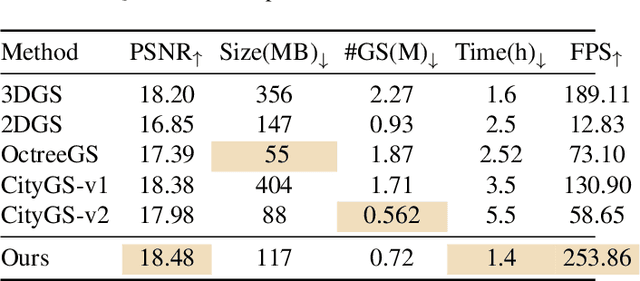
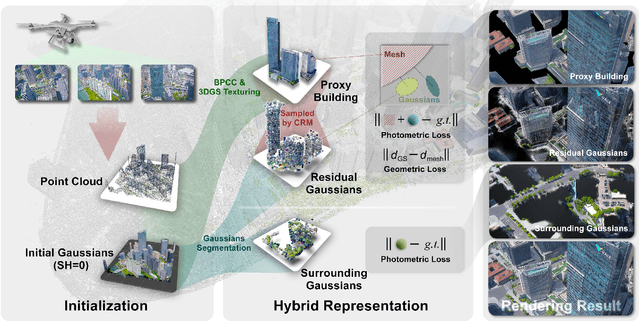

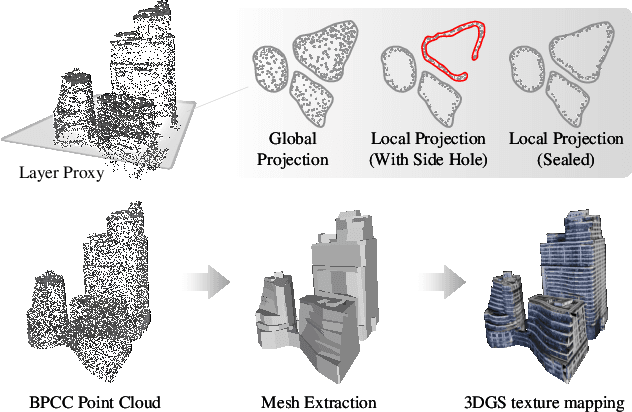
Accurate and efficient modeling of large-scale urban scenes is critical for applications such as AR navigation, UAV based inspection, and smart city digital twins. While aerial imagery offers broad coverage and complements limitations of ground-based data, reconstructing city-scale environments from such views remains challenging due to occlusions, incomplete geometry, and high memory demands. Recent advances like 3D Gaussian Splatting (3DGS) improve scalability and visual quality but remain limited by dense primitive usage, long training times, and poor suit ability for edge devices. We propose CityGo, a hybrid framework that combines textured proxy geometry with residual and surrounding 3D Gaussians for lightweight, photorealistic rendering of urban scenes from aerial perspectives. Our approach first extracts compact building proxy meshes from MVS point clouds, then uses zero order SH Gaussians to generate occlusion-free textures via image-based rendering and back-projection. To capture high-frequency details, we introduce residual Gaussians placed based on proxy-photo discrepancies and guided by depth priors. Broader urban context is represented by surrounding Gaussians, with importance-aware downsampling applied to non-critical regions to reduce redundancy. A tailored optimization strategy jointly refines proxy textures and Gaussian parameters, enabling real-time rendering of complex urban scenes on mobile GPUs with significantly reduced training and memory requirements. Extensive experiments on real-world aerial datasets demonstrate that our hybrid representation significantly reduces training time, achieving on average 1.4x speedup, while delivering comparable visual fidelity to pure 3D Gaussian Splatting approaches. Furthermore, CityGo enables real-time rendering of large-scale urban scenes on mobile consumer GPUs, with substantially reduced memory usage and energy consumption.